Showing posts with label fly casting instructor. Show all posts

Thursday, August 21, 2014

CASTING COACH: Two-Handed Casting Grip

Before we go any farther with single-handed casting, I want to stop and introduce a couple of things about two-handed casting. There is a lot of interest in two-handed casting these days. Two-handed casting is as simple as single-handed casting. I want to introduce the two-handed casting grip here because much of what we learned about single handed casting up to this point is EXACTLY the same for two-handed casting. So, you might as well come to the realization that you are learning important things about them both at the same time, whether you previously realized it or not. And for those of you that already have single-handed casting down and are interested in two-handed casting, this will show you that you are already farther down the road than you thought.


Knowing the point of balance of your 2-handed rod is important. This point is where you will place your hand on the forward grip. Gripping the forward grip in this place cuts back on fatigue because you won't have to grip the cork so tightly to lift the tip off the water all day long. Now, if you have shorter arms and want to move that balance point back a little, you can add weight to the reel or get a heavier reel. This is one reason you should consider getting your reel after you get your rod. Shoot me a note if you would like for me to share with you how to properly balance your rod (too much info for this segment). Also, depending on what you are casting, you may need the forward hand closer to or further from the reel. You may need to move your hand up further on the grip when using long belly lines. You may need to move the hand closer to the reel when casting short belly lines like Skagit or Scandi lines. Shorter belly lines require more use of the bottom arm to casting the short belly lines. So, find the balance point of your rod and then work on your grip from there.


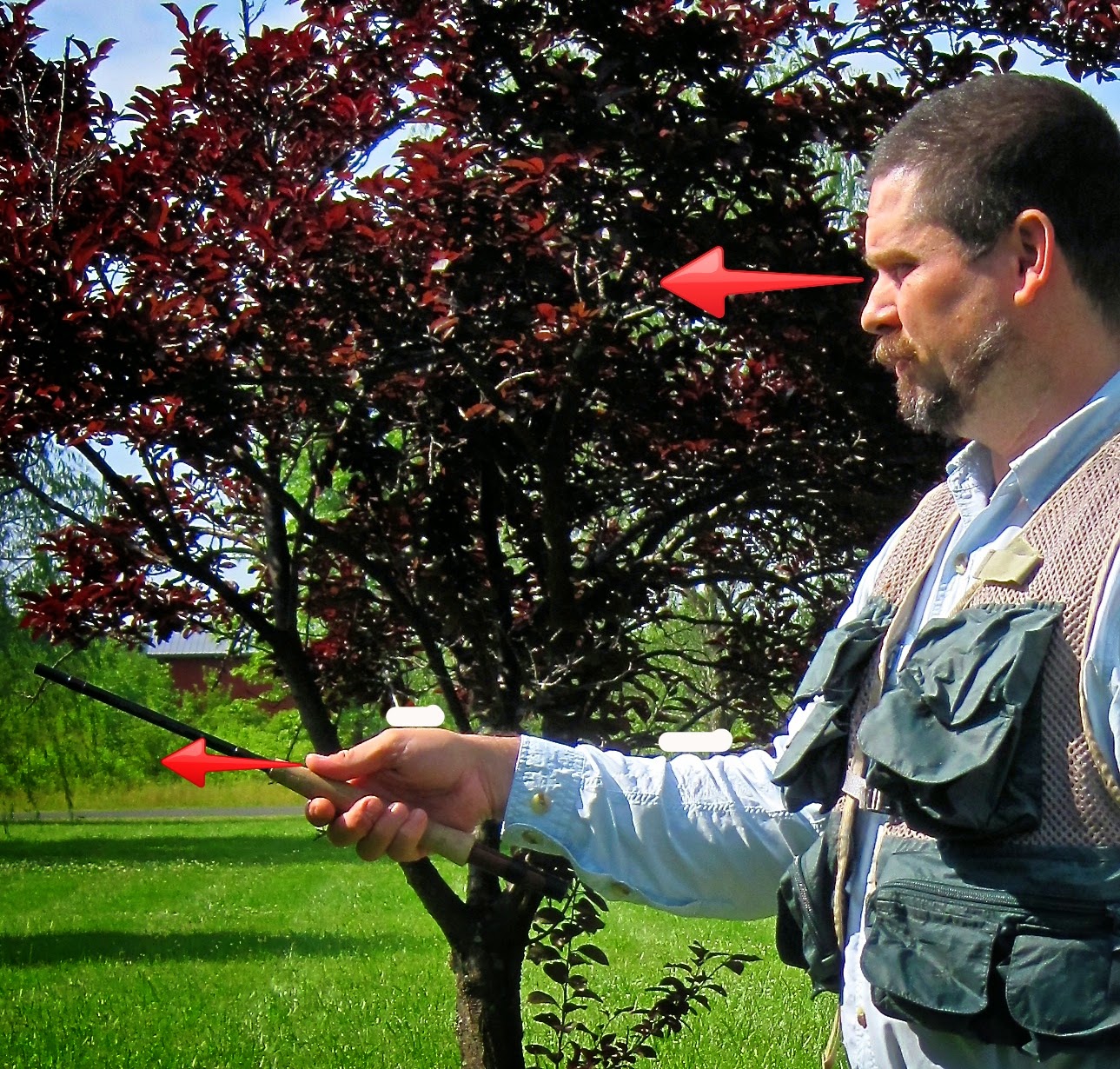
Now, look back at our lessons on how to grip a single-hand rod. The grip on the forward rod grip of a two-handed is the EXACT same grip.

See, you already know what to do. More important, I want to you focus on the position of the rod in this picture. This picture represents that point right after a cast. Notice the forward rod grip is right along my forearm and the back grip is practically in my armpit. Practice holding the rod in this position, build muscle memory for this position, and make it feel natural. This combined grip needs to be wide and the back grip needs to be in next to the body at the end of a cast (not extended a foot away from the body). Trust me! Practice this position. Make it second nature. Fixing this now will make your casting so much easier when we start discussing it.


This is just a view from the opposite side of the body. 

Grip the Back Grip with your opposite hand as if you were shaking the rod's hand. Now, relax and be comfortable with that grip. No hard white-knuckling squeeze is necessary.

This picture is also a great place to discuss stance. 

As with the grip, stance should be comfortable and allow you to make the necessary rotations and transfer of body weight needed to cast. 

If you cast right-handed you want the left foot forward so that you can rotate around to the right. If your right foot is forward, you cannot rotate enough (back to the right).

If you want to make a cast from the opposite shoulder or cast left-handed, switch your feet so that the right foot is forward to allow for adequate rotation to the left.

While you are practicing the grip and post-cast positions, be mindful of your stance as well and get used to it.

Work on all of the things suggested in this series. Build your muscle memory and make it comfortable. You'll be ready for the next lesson of roll casting with the two-handed rod in no time!

Are you ready to work on your casting? Call me. LET'S GET CASTING!

Saturday, August 16, 2014

From Grandpa...

Jacob's grandmother called me a few weeks ago. His grandfather passed several years ago and left Jacob some fly fishing gear. Now that he is about to turn 12, she wanted to get him some casting lessons so he could put the old fly rod to work. Of all of the stuff we do at Fisher of Men Outfitters, this is the stuff I live for! What a great time introducing the next generation of fly fishers to the sport. Jacob really took to casting quickly. Below are the feedback pictures I sent to Jacob this morning. These pictures are not staged. They are photos I take throughout the lesson as we work on each technique. This is the stuff I do for each casting lesson so that you have a way to better reflect on your lesson and make ongoing adjustments.

Are you ready to start casting or tweak your casting? Call me! LET'S GET CASTING!


Monday, August 11, 2014

False Cast

We were working on false casting to increase line speed, move line, and tighten loops on the stream yesterday. Visualize that line rolling off of the tip of your rod. 

As I told Steve, the 1st rate limiting step to fly fishing is being able to cast enough line to get an offering to the fish. False casting like this can better help you not only visualize what your line is doing, but also help you feel what the rod and line are doing as you make LOADING MOVES to POWER SNAPS.


Are you ready to take your game to the next level? Call me! LET'S GO FISHIN'!


Monday, August 4, 2014

CASTING COACH: ROLL CAST

The Roll Cast is a most important cast. Not only is it the simplest cast for beginners, but it might just be the most versatile and most important cast you learn. In fact, I'd say, when casting small streams, it's far more important than overhead casting.

The Roll Cast includes all of the 3 steps we learned in our last lesson: Loading Move, Power Snap, & Follow Through. The difference being that the roll cast has only a forward cast (no backcast). As with everything we have discussed so far, attention to the details of hand/arm positions is fundamental to a good roll cast. So, stay focused on the hand and arm and you will be making perfect roll casts in very short order. The steps are outlined with the photographs below.


In this starting position, just check a few quick things. The grip needs to be proper and relaxed. A target needs to be chosen (we never just cast at nothing...right?). While you can roll cast with a square stance, this is a good time to check your stance. Have the foot of the casting arm slightly back. This will be more comfortable and get you used to this important position. Having that foot back will allow rotation at the hips which will be important later with other casts. 

Once you are ready, then lift the rod (tilted out slightly) to the position we learned for the backcast in previous lessons.


Once in the backcast position, you have all of the time in the world to make your roll cast. So, RELAX and CHECK ALL OF YOUR HAND AND ARM POSITIONS.

If the hand and arm positions are correct, confirm that your line is making a D-Loop behind you (it will make the shape of a "D" with your rod).

Ok, hand/arm positions are correct and you have a D-Loop. Now we're going to make our 1st LOADING MOVE to a POWER SNAP.

The LOADING MOVE (motion which causes the line to load energy into the rod) consists of rotating the arm down at the shoulder joint and extending the forearm at the elbow joint. The motion is most easily thought of like a chopping motion with a Tomahawk (though not that forceful).


This image just helps you better visualize the need to have the rod tilted slightly out to be able to form the D-Loop.


As you come down to this position with the LOADING MOVE, the POWER SNAP consists of the position we learned for the stop of the forward cast.

The POWER SNAP consists of an abrupt stop while simultaneously pressing the rod grip with the bottom of your thumb and rolling pressure to the bottom of the rod grip sequentially from the 5th finger to the index finger. Remember, you are stopping with the end of the thumb pointing right at your target. 

As quickly as you made the abrupt stop with the POWER SNAP, relax your grip and gently lower your rod tip for the FOLLOW THROUGH.

BANG! You got it! Take your time, relax, check all of your positions, and practice practice practice. This is easy if you just use the skills you have already learned and now put them together.


Sometimes the wind is working against you, blowing from your casting shoulder across your body. When this happens it will blow your D-Loop right into you and make is difficult to complete your roll cast. What to do?

It's simple, you'll just roll cast off of your opposite shoulder this time. The steps are the same except this time you will bring your grip up to the level of your forehead lined-up with your nose in the center of your head. Tilt the rod over your opposite shoulder this time and let the D-Loop form on the opposite side of your body.

Relax, check all of your positions, and proceed with your LOADING MOVE, POWER SNAP, and FOLLOW THROUGH.


From the back so you can see the proper rod tilt for roll casting off of the opposite shoulder.

Once you have mastered this you will be half way home with the basic overhead cast. Remember, focus on mastering the fundamentals of the hand and arm positions for each of these steps and you will cut years off of becoming a fantastic fly caster!

Are you ready to start casting or improve your casting? I can help you with that. Call me! LET'S GET CASTING!

Wednesday, July 16, 2014

CASTING COACH

1. Loading Move
2. Power Snap
3. Follow Through 

For the next several days while you are perfecting your grip and working on the hand and arm positions for the forward and back casting strokes, MEMORIZE these 3 phrases in this sequence. Be able to repeat them instinctually. 

Next week we will start casting with the Roll Cast. We will combine the 2 previous lessons with this sequence and make a perfect roll cast. You'll want to be able to speak these 3 phrases as you are doing them, so memorize them now and then we will put them to work.


Are you ready to start fly casting or take your casting to the next level? Call me. LET'S GET CASTING!

Thursday, July 10, 2014

CASTING COACH

You've practiced your grip for a few days and have learned not only how to position the rod grip in your hand, but you've also learned to relax the hand around that rod grip. The next step in learning fly casting or improving your casting is to focus on what you need to be able to do just with the rod hand and arm. Focus right here for a few days and when it's time to start casting, it will be oh so easy.

All we want to do now is focus on what happens with the hand and the arm when they stop for the forward cast stroke and the backcast stroke. There is a lot happening here and it is important to get each piece of this foundation correct to move to the next step.  So, focus on the details and positioning...it will be worth it.


The 1st thing to focus on with the forward casting stroke is the position of the wrist. Notice that the back of the thumb (actually the 1st metacarpal) is in line or parallel with the forearm. The elbow is bent and mildly extended, though you are not reaching foreword. The rod butt will be parallel to the bottom of your forearm. The end of your thumb and your eyes are pointed towards your target. Make sure you always have a target. You have to be casting to something. Know what it is with every cast!


When you are making the stop for the forward casting stroke, you are simultaneously pressing the rod grip with the bottom of your thumb and rolling pressure to the bottom of the rod grip sequentially from the 5th finger to the index finger (this rolling pressure is what allows your fly line to properly roll over the tip of your rod and make a nice tight loop). Remember, you are stopping with the end of the thumb pointing right at your target. And, it is an abrupt stop and then a relaxed grip. Keep your shoulders square and keep your eyes focused on the target.

Right now, all you need to do is work on emphasizing these positions and gaining muscle memory with them. This part of the exercise does not yet involve casting or loading moves or follow throughs. You are teaching your brain and your muscles what it feels like to end right here.


The stop for the backcasting stroke involves another set of steps and positions. As with the forward casting stroke end position, this position also ends with an abrupt stop. The positions here are crucial to a good backcasting stroke and overall efficient casting
First, notice the top of the thumb (not the 1st metatacarpal, but the top of the thumb (proximal phalanx)) is now parallel with the forearm.

You are stopping the hand at the level of the temple or top of the ear (which ever is easier for you to relate to). The end of the thumb is pointing straight up now. If all of this is correct the rod butt should now be at a 45 degree angle to the bottom of the forearm. The upper arm has lifted (or arched really) up so that the forearm and upper are are at a 90 degree angle.

One thing that can help you know you are at the correct level is that you should still be able to see the end of your thumb with your peripheral vision. If you cannot your hand is likely too high or too far back.


When you make your abrupt stop for the backcasting stroke, all you want to do is just squeeze the rod grip. A quick abrupt squeeze to a stop and then relax. You have to relax after the squeeze to the stop so you are able to feel that rod load in the backcast in order to get ready for the next step. Sometimes when you are really focusing on all of these steps, positions, and angles, it is difficult to then relax that grip. But you have to focus on that too.

So, until next time, work on all of these positions for the foreword casting stroke and the backcasting stroke. Be precise. Pay full attention to each little piece. Don't worry about casting yet. We will get to that. For now, just build these proper positions and muscle memories.


Are you ready to start casting or improve your casting? I can help with that. Call me. LET'S GET CASTING! 

Saturday, July 5, 2014

CASTING COACH

As with all things, great fly casting starts at, well, the beginning. To get a grip on casting you have to start with the grip. An ideal grip allows the muscles of the hand to fully engage the rod's action
With the wrist bent down, the rod grip should rest lightly in your bent FINGERS. The HEEL of the hand should rest on top of the grip. The THUMB rests on the top of the grip with the pad flat. Notice there is space between the muscles at the back of the thumb and the rod grip.

Now, just spend some time holding the butt-section of your rod in this relaxed position. Get used to gently comfortably holding the rod with the proper grip. When teaching my daughter how to cast, I actually just had her walk and sit around the house holding the rod properly and relaxed. You want to build a muscle memory that is relaxed while holding the rod. This will allow you to feel and respond to the rod as it loads and unloads line.  A tight grip with you white-knuckling the rod will never help your casting.


Use this picture to help you visualize not only where the rod should be in your fingers, but also how lightly the rod should always sit in your fingers. Remember, the fingers, thumb and heel of the hand are on the grip to not only guide the rod, but to detect feedback from the rod. A death-grip on the rod will only hamper that ability.


So, the rod grip is resting lightly in the fingers. Now just take note of the position of the fingers, thumb, and heel of the hand with a proper grip. And don't forget to have a grip that leaves some space between the muscles at the back of the thumb and the rod grip. Also notice with a proper grip, the rod butt is parallel with the forearm. If you have a smaller heel to your hand, the rod may even rest in contact with your forearm in this position.


Again, just take notice of the position of the fingers, thumb, heel of the hand, and the rod butt from a top view.

Now, practice practice practice. Stay relaxed. And we'll have another CASTING COACH tip for the next step soon!

Fly casting is far more simple than you might think. If you're ready to start casting or improve your casting...call me. I have a variety of casting instruction options to get you going. LET'S GET CASTING!

Wednesday, May 14, 2014

Casting Instruction and Coaching

From your grip, to lifting line off of the water, to your loading move, to your power snap to unload the rod, there is a lot to learn about fly casting.  Behind every great fly fisherman, there is a fly caster that has to know how to get his/her offering where it needs to be in an efficient manner.

So, who needs a casting lesson?   Just about everyone...

We have worked diligently over the past several years to put together a variety of casting instruction packages to meet the needs of just about anyone who owns a fly rod.  And most importantly, we have spent a ton of time not only teaching casting, but sitting at the feet of a casting guru to learn her perspective specifically on casting instruction.


Packages:

1. An Hour at a Time:  This is for the fly caster that just wants to get together occasionally for an hour at a time to work on a particular aspect of their casting or learn new skill.

An Hour at a Time is $60/hr.

2. Casting Coach:  This is the ideal way to learn and improve your casting.  Casting Coach consists of a package of 5 sessions.  Each session is an hour long.  We start at the beginning with the basics of fly casting and send you home after each session with a set of directed tasks to work on until our next meeting.  Initially, you might think some of this is too basic, but when we are all said and done, you'll be happy we went back to the very beginning and started fresh.  Having a solid foundation of fundamentals is the key to a lifetime of casting pleasure.  When your foundation is solid you can then advance to hauling and/or 2 handed casting with ease.  Think about Casting Coach as no different than hiring a golf pro to work on your golf game.  This is the exact same idea.

A 5 session Casting Coach package is $250.

3. Casting School:  I have a team of coaches ready to get together and do a 2-3 consecutive day school for your group. These schools can be tailored to your group's needs and can be as lite or intense as you need.  We will develop the casting school around your needs and can come to you or we can schedule a destination retreat of your choosing as well.