Showing posts with label Steelhead. Show all posts

Sunday, March 15, 2015

TIPS FOR STEELHEAD ALLEY AFTER ICE-OUT

Don't stand under that to fish.
Dat will get you kilt!
1. BE SAFE! I know this should go without saying, but it's been a long cold Winter. And it's easy to get caught up in some long anticipated fishing and not be aware of your surroundings.

**There are still large chunks of ice coming down the rivers. They can take your legs right out from under you.

**Don't stand under ice on high banks. They can fall at any time as the weather warms. I watched it happen 5 times yesterday.

**The water is COLD! Water temps at ice-out are about 33 degrees because of melting ice and snow. You are essentially fishing a flowing glass of ice water. If you were to get hit by a big chunk of ice, you are not only going to be injured, your are taking a bath in ice water. And now you might be hurt and hypothermic. If you don't have buddy with you or access to immediate help, that can be a recipe for dead unsure emoticon

He INHALED a single
pink egg
The take away is PAY ATTENTION. Better to miss a fish than not get home smile emoticon

2. The water is COLD. Is there an echo in here? The water temp actually drops at ice-out because of the melting ice and snow. And while steelhead are cold water fish, 33 degree water temperatures do slow them down. So, while that 50 degree air feels good to you, that is not yet what the fish are experiencing.

**Fish slow. Take your time and continue to cover those slower deep Winter holds. Focus on putting your offerings near the bottom and along structure and shelves.

**The bite can be very subtle in these conditions. Pay attention or you'll miss it.

Pink, fl orange, and chartreuse
sucker spawn is essential as
suckers run in early Spring!
3. While steelhead are always a sucker for single eggs and sucker spawn, this is the time for STONE FLY NYMPHS! Tiny black Winter Stone Flies were flying around all afternoon yesterday. The fish you are targeting right after ice-out have been in the system all Winter are currently eating these stone fly nymphs.

**A black stone fly and egg combo is pretty effective during this window. I use #14 black stone fly nymphs. You could absolutely go smaller if the water is clear. Frankly, I use the #14 because even with my trifocals...I can't see to tie on anything smaller wink emoticon Don't get old!

Let's meet on a warmer day next time.
We worked really hard yesterday and picked up 9 steelhead in the ice bath. You can do it. Be safe, slow down, and consider black stone fly nymphs and an egg combo.

If you're struggling, we have a few dates left for the Spring run. Call me. LET'S GO FISHIN'!

Friday, December 26, 2014

COLD FEET!


Winter steelheading goes hand in hand with cold feet.  One of the the things discussed often this time of year is how to keep your feet warm in this cold weather.  Luckily, of all the things I like to discuss about fishing…how to keep your feet warm and healthy is something of which I just happen to be an expert.  And, that expertise is not just from my experience over the years.  I just happen to have an earned doctorate dealing specifically with the medical and surgical care of FEET :-)

You really just need a little understanding and then to keep in mind a couple of simple rules to keep your feet comfortable in cold water.

You have to start with a little understanding of the circulation to the feet.  The feet are the farthest structure in the body from the heart in reference to strong circulation and perfusion.  That is the 1st important thing you have to understand.

When the body starts to get cold, it is going to maintain it’s primary focus on maintaining core temperature before it concerns itself with increasing any blood flow to the feet to keep them warm.  If your core is cold, your brain will actually cause vasoconstriction, or slight slowing of the circulation to the feet and hands to make sure the vital organs stay warm and function properly.  So, the 1st thing you want to do to keep your feet warm is to layer your core correctly to keep it warm so that the body itself does not want to restrict any of that warming blood flow to the feet.

If you understand that basic piece of human physiology, you are off to a good start.  Now that we have the body on our side, we have to take a couple of measures to help the feet stay warm.

First, you have to properly layer the right types of stockings on your feet to keep them warm.  The most important thing you have to lose is COTTON SOCKS.  This type of sock has poor insulation value and holds any moisture from perspiration or leaky waders right against the skin…resulting in heat loss.  So, dump the cotton socks.

The 1st layer of sock I recommend directly against the skin is a knee high stocking made of a microfiber blend that will wick any moisture away from the skin.  I recommend this layer being knee high because you want that sock to wick any moisture up and away from the feet.  A short sock to the level of the ankle cannot get that moisture past the boot, and since all waders leak and your feet will likely sweat some, you want that layer against the skin to be able to wick any moisture up and away.

Now that you have the correct 1st layer, you want to add a bulky insulating 2nd layer that will create insulation value and also be able to wick any moisture as well.  BULKY is the key here.  This layer creates a layer with some air in it to increase the insulation value.  Wool is really optimal here.  I like wool from sheep, but alpaca wool is even better because is seems to be a little stronger and compresses less from walking and boot pressure.  There are also a number of bulky stockings out there now that are blends of wool and microfiber that are viable options.

I also add a 3rd layer.  Several companies out there have thin neoprene stockings.  Now, if you make the neoprene the layer against your skin, it will hold any moisture right there and just result in heat loss…ultimately making your feet cold when fishing in cold water.  BUT, if you make the thin neoprene stocking your outer most layer it will act as an excellent insulator and help keep the warmth you have from escaping so rapidly.  And, if you are using a breathable wader with neoprene stocking feet you are now really helping to increase that insulation value.  

If you have ever been involved in scuba diving in moderately cold water, and you couldn’t use a dry suit, you probably used a farmer John neoprene dive suit.  The value of that type of suit is that it doubles the layers of the neoprene over your core to help keep that body heat you’re generating in around your core.  The same principle can be employed here if you layer correctly.

The second thing you have to consider after layering correctly is NOT compressing or squeezing the foot so tightly with those layers and your wading boot that it actually inhibits the proper circulation to your feet.  So, if you layer correctly, but your wading boots become so tight that it is squeezing the circulation right out of your feet…you have accomplished nothing in keeping your feet warm.  Remember, we layer the core correctly so that the body does not restrict blood flow to the feet, don’t make the layers so tight on the feet that you then restrict blood flow to the feet.

I actually have Winter wading boots that are a size larger than what I wear when I don’t need to layer so much.  If you are going to wade in the icy cold waters during the Winter months, this is something you need to consider.

The last thing to consider is to keep moving throughout the day.  The most important thing anyone can do when they have any kind of circulation issue to the feet is walk and keep the circulation moving.  Now, as a Winter steelheader, you probably know that the fish tend to be in slower pools and you find yourself staying in one spot longer than you might in warmer conditions.  So, make yourself move around some.  Walk to another hole, preferably out of the water to get and keep that circulation moving. 

Keeping your feet warm in the Winter is not as difficult as it may seem if you follow these simple rules.  And keeping your feet warm will keep you on the water longer to enjoy your fishing!

Now that you can keep your feet warm in the cold, let’s take your Winter steelheading to the next level.  Call me.  LET’S GO FISHIN’!

Wednesday, November 19, 2014

ICY GUIDES?


It's getting cccccold. The main complaint I hear about fly fishing in the cold is icy guides. Sooo, is there a way to cut back on how much ice forms in those guides? Glad you asked!

Certainly use an ice-off paste. Apply it the night before and then reapply as needed through your fishing day.

BUT, is there more to it than that? Remember, your WET line constantly moving through the guides is really what leads to all of that ice. Maybe you could do some things to reduce how much water you pull through those guides to make all of that ice?

You want to maintain good drifts, tight lines, and recast while moving minimal line through the guides. WHAT?


I have several focuses when I'm fishing in the ice box.
1. Do as much roll casting and flipping of your line as you can. By "flipping", I mean water loading your rod at the end of your drift and casting or "flipping" the line back up stream without overhead casting at all.
2. Make good mends to maintain your drifts, BUT instead of pulling line in through the guides to keep "tight" consider managing the line with other methods.
A. High stick, even when indi fishing
B. Take a few steps forward or a few steps backwards to keep from having too much slack line.
3. Keep the rod tip out of the water.

See, you can keep out all of the line you like, make good drifts, cast, and still keep from constantly moving wet line through those guides....until you catch one. But hey, that's worth clearing some ice from the guides at that point!


And last but not least, the less you are running wet line through your guides, the less it is winding on to your reel as well. And that helps prevent that reel from freezing solid and then getting broke off by a trophy fish. Just remember to wind that reel a half rotation or so now and then to make sure it isn't frozen up.

Winter Steelhead trips will refine your game better than any other time of year. As long as the creeks are not frozen...we're fishing. Call me. LET'S GO FISHIN'!

Sunday, October 26, 2014

Simplifying the Great Debate: Fluorocarbon vs. Nylon: INVISIBILITY

I read and hear conversations all of the time debating the advantages & disadvantages of nylon monofilament vs fluorocarbon monofilament for leaders and tippet.  Once again, the real question is:  How much of the stuff you hear/read on this topic is truth versus marketing hype?  Let’s see if we can sort some of this out.


TRUTH:  Fluorocarbon has a closer refractive index to water than that of nylon.

Yes folks this is a cold hard scientific fact.  Refractive index essentially refers to a number indicating  how much the speed of light is reduced in a given medium.  I just got a headache from typing that.  Water has a refractive index of 1.3330.  Fluorocarbon has a refractive index of 1.42.  Nylon monofilament refractive indices range from 1.53-1.62.  BUT, does that really mean fluorocarbon is invisible in water?

MYTH: Fluorocarbon is nearly invisible to fish in water.

Clear back in 2001 a guy named Jeff Thomson wrote an article called, “Mathematical Theory of Fishing Line Visibility”.  Now, I can’t find that this is an actual peer reviewed published article, but I have read the presentation he did on the topic and it is pretty good.  He essentially breaks down how light refraction, reflection, and scatter in water works from a mathematical equation perspective and then applies the properties of water and fluorocarbon in those equations.  It’s painful to read if you do not have a science and research background (and even then, it’s pretty painful).  He ultimately concluded that considering all of the variables involved, in reality, fluorocarbon monofilament is not “invisible” in water.

Anecdotal evidence (a limited selection of examples which support or refute an argument, but which are not supported by scientific or statistical analysis) by many fisherman suggest that, yes fluorocarbon is less visible to fish than nylon monofilament.  So, is this true?  Maybe…

A lot of folks have reported many types of tests to quantify this (non-scientific tests, but interesting nonetheless).  People have put lengths of same diameter nylon and fluorocarbon in glasses of water, aquariums, in lakes and rivers, and looked at them and photographed them.  The majority of those folks report they can’t see a difference between the two.  Of course they all admit they are not fish under water looking at the materials with the naked eyes of fish.


My own anecdotal evidence suggests that in clear water, steelhead most certainly see fluorocarbon monofilament line when it drifts towards them and they move out of the way from the offering (no matter what it is) well in advance of it ever getting to them.  While I cannot write a peer reviewed scientific paper based on my observations, I’m comfortable saying, in gin clear water….fish can see fluorocarbon monofilament line.

YET, I do construct my leaders from and use tippet material made of fluorocarbon.  Why is that if it is not invisible and certainly costs more?  For me it’s simple.  I guide clients with varying degrees of experience.  And fluorocarbon does give me some advantages. 

Fluorocarbon has higher tensile strength at smaller diameters than nylon.  I want to give clients every advantage I can, knowing full well when they are with me they are in the middle of a big learning curve on how to catch steelhead on the fly rod.  So, it is true, fish are less spooked by smaller diameter line and if I can use a smaller diameter line that is stronger to help a client get a fish to hand, it’s a win win. 

Once someone is comfortable with proper presentation of offerings and how to land a big crazy fish on fly gear, many of the reported advantages of fluorocarbon may not be as significant.  From my perspective, I have a very limited amount of time to spend with any given client to cover a ton of material and get some fish in their hands.  In that setting, fluorocarbon limits some of the issues with presentation error and helps a little with not breaking off fish when making common mistakes fighting and landing these big fish. 

From my personal fishing perspective, at the end of the day, hooking fish still comes down to precise PRESENTATION PRESENTATION PRESENTATION.  In my opinion, the visibility of the line plays very little role in whether I hook fish.  And there a a multitude of other ways we spook fish and shut down a bite before we ever get out lines in the water.  In previous articles we have discussed that fish see a lot in an out of the water that does not even relate to line visibility.  And this does not even account for things we do unknowingly that disturb a run before we even get close to it.  We would be hard pressed to narrow why we are not catching fish down to the visibility of the line we use.  But it can be a piece of the overall picture that also should not be neglected.


To me, it’s more of an issue of making the right kind of presentation in low gin clear water than having an invisible line.  For example, swinging an offering down in front of fish presents only the offering to the fish (not the line), where drifting an offering does tend to present the line and offering at the same time.  And in the case of Steelhead Alley steelhead, they get educated to line drifting at them pretty quickly from the moment they enter the tributaries.

I’ll discuss other topics within this specific debate in upcoming articles.  Until then, if you’re gonna be in northeast Ohio or northwest Pennsylvania on business and want to spend a day on the water or you are local and just want to work on some aspect of your steelhead game…call me!  LET’S GO FISHIN’!

Sunday, October 19, 2014

Fish Vision: Color Underwater

Now that we know what fish see above the water’s surface, what do they see in the water?  Let’s start with color.  

We discussed in the previous article that water has different optical properties than air.  Water is about 780 times more dense than air.  As light hits water, not only does the light bend, it is selectively scattered and absorbed.  Greater than 75% of the visible spectrum is absorbed within about 30 feet.

Here’s what you need to know and think about.  In clear water, the colors we see as red, yellow, and orange are lost first.  “Lost”, meaning scattered and absorbed.  The colors we see as violet, blue and green reach farther, with blue penetrating to nearly 500 feet.  How far light penetrates on a given day depends on the angle of the sun, the roughness of the water’s surface, and how much sediment is suspended in the water (turbidity).

Light intensity plays a big part in how a fish perceives color. Fishing on a sunny day will allow light from the sky to penetrate much deeper through the water column than on a day with clouds. Shiny colors like silver and gold are less effective when cloud cover rolls in, and can become almost invisible without the sun shining, even in clear water. The reason for this is that they reflect the grayness that is surrounding them, instead of the bright rays of the sun. Casting darker colors (like blues and purples) in low light (whether due to cloudiness, early or late in the day, or water with a high amount of suspended sedimentation) often work best by giving your fly the greatest contrast and silhouette. 


***So remember, as the sun sets (or at sunrise), cloudy days, or in stained water, colors like red, yellow, & orange will disappear the quickest. Blue, violet, and green are seen by fish much better in these low light conditions.

Now, what about all of these shiny materials and UV enhanced materials we see for files these days?  Great question!  Glad you asked.

First, there is some research that suggests that fish can sense polarized light (where we humans cannot separate polarized light from regular light).  Polarized light is unique in that it only vibrates in one plane.  I know, blah blah blah, but stick with me here.

When light is reflected off many nonmetallic surfaces, including the water’s surface, it is polarized to some degree.  Your polarized sunglasses block horizontally reflected light from the water’s surface, permitting only vertically reflected light through…thus reducing glare.


What does all of this have to do with fish vision?  It’s thought that fish that can see polarized light use the ability to help them find food.  When light reflects off of surfaces like fish scales, it becomes polarized.  A fish with polarizing vision can more easily make out baitfish and not lose them in the background of the plants and or rocks in the water.  It is also thought that fish with polarizing vision can see objects as much as three times further away.  AND, polarized light is most abundant at dawn and dusk.  Way back in 2001 a great study was done that showed in Oncorhynchus mykiss (our beloved steelhead), polarization sensitivity may provide these salmonids with an improved means of locating prey.  (That’s as crazy technical as I’ll get in these articles. I promise!) Now, this study was in juvenile fish.  There is some research that suggests that mature salmonids lose the ability to see polarized light.  And there is other research that suggests that salmonids regain that ability for a time when they reenter the rivers and streams to spawn.

Now you understand why many companies that make materials for fly tying are manufacturing “Polar” products.  Steelhead may be able to see them better, from further distances, and in lower light.  And this is how they look for food, at least as juveniles.  Think you might want to use this stuff in your flies?

What about all of this “UV” stuff (UV = ultraviolet light)?  It’s similar and pretty simple.  There is research that shows that colors that fluoresce in UV light are visible and distinct for longer distances than regular colors.  BAZINGA!  UV light is most is dominant on cloudy or gray days.  On sunny days, the fluorescence is much less.  So, under the right circumstances, we can take advantage of materials that fluoresce under UV light to gain a more visible and vibrant presentation.


All of our flies are used to imitate something fish feed on.  And at times, it can help to add in materials that can be seen by fish that can see polarized light and it can help to add fluorescent or “UV enhanced” materials to make the fly stand out.  Of course you must also understand that these enhancements could work against you when chasing fish that are in areas with abundant forage.  Fish key in on “hatches” very specifically at times because they are safe.  It is against their instinct to eat something unusual in those situations because it presents more risk to them.  So, you have to chose wisely for each situation.

Hopefully this gives you a concise little primer on why and when we use the colors and materials we use for various fishing conditions.  If you need more help drilling down your steelhead game…call me!  LET’S GO FISHIN’!

Saturday, October 18, 2014

Fish Vision: Above the water

What do fish see?  I was asked this question at a steelhead exposition a few weeks back.  My initial answer was, “That is a much broader question than you might think.”  How fish see out of the water, in the water, and how light effects what they see is has been the topic of study for many many many graduate students and other researchers around the world.  It’s a great question.  And if you can have a basic understanding of a few of these concepts, it really can impact your fishing.


Let’s start with: What can fish see above the water?  First, you have to understand that fish live in water and water has very different optical properties than that of air.  Depending on the angle  light hits the water, a calm water surface can reflect up to 80% of the light hitting it.  And in rough water surfaces, there is tremendous variance in the transmission of light no matter what angle the light hits the water. 

That may sound technical, but it matters.  You are already starting to get an idea of why you can easily approach fish in some water and they are very spooky in other waters.  Surface movement of the water and the angle at which light hits the water plays a big role in what fish see out of the water.


The next concept you have to understand is that light bends (or refracts) when it enters the water.  So?  So, that allows each eye of the fish to see a certain area above the water that works in a different way than we normally see things.  Nearly everything a fish sees above the water appears in a circle (more of a cone really).  This circular window is smaller for fish close to the water surface and becomes larger the deeper the fish is in the water.  Outside of the window, the surface of the water appears as a mirror, reflecting the bottom. If the surface is choppy, the mirror effect is reduced.  In rough water this circular window is broken up and light is transmitted through continuously changing patterns. 

Yes there is a lot going on here. But you just need to be aware that fish see in a circle or cone above the water.  The circle is bigger for deeper fish and smaller for shallow fish.  You want to stay out of that cone.  To do this, you need to be back away from the fish and low to the horizon.  And there are other things that can help.  Low light conceals you even more and rougher water is further helpful.  And now you can see why fish in smooth water on a sunny day just scatter as you approach them.  


I tell folks everyday, “Know where the fish should be for the day’s conditions and fish for them in those places.”  Do not get fixated on fish you can see, rather fish the places they should be.  And those are places you cannot normally even see the fish.  Now you better understand why the fish also struggle to see you if you approach them correctly in these places.  That is a combination that makes for a great day on the water.  It also helps you understand how precise things have to be on those occasions when you are sight fishing.

Are you ready to take your steelhead game to the next level.  I can help you with that.  Call me.  LET’S GO FISHIN’!

Monday, October 13, 2014

GUIDE?


guide
n.
   a. One who shows the way by leading, directing, or advising.
   b. One who serves as a model for others, as in a course of conduct.

I tell people all of the time, "In life, you either are a guide or you are not."

Some folks gravitate towards teaching others, no matter what they are doing. That certainly has been the case for me, whether it was coaching wrestling, teaching students & residents, guiding patients, or guiding fly fishing adventures. One either lives to teach or they don't.

I was talking to a young man just getting into the guiding business a few weeks ago. It was a great conversation. He has all of the tools be be a great fishing guide.

Even if you are not a guide, stay with me...it matters to all of us in the end.

The young man was concerned about the actions he had observed in other guides. The first thing I told him was that you cannot control the actions of others. So spending time losing stomach acid over things you cannot control will only make you sick and not help the situation.

Most importantly, we discussed the role of servant leadership. The way to change the world is not to scream, yell, and bully others into your view. In fact, the way to change your world is to lead by example.

I told him we all make mistakes along the way, but what matters is that we pick ourselves up and get better tomorrow from today's failures.

A most important concept for a guide of any type to embrace is that it is NEVER our job to judge clients (or other guides for that matter). Clients come to us with a variety experience and backgrounds. Some have never picked-up a fly rod. Some have traveled the world. Some are just easy to be around. Some are difficult to spend a day with.

Whatever their experiences and attitudes, our job is not to judge them, but to guide them. Our job is to lead the way and find a way to lead them. Our job is to find common ground to reach them and relate to them so that they get out of the day what they need.

Our job is never to compare our experiences and worry about whether we could have caught more fish, handled fish better, or just had a better attitude in general. Our job is to gently lead.

One of the hardest notions to get past as a guide is that the client should meet our expectations. We have to enter every day with only one expectation and that is to meet the clients needs for the day. A client will likely never meet our expectations because they do not have our experience. Spending your day irritated because a client does not know everything you know should leave you considering a different vocation. In saying that, quite often it is important to be able to reset a client's expectations for the conditions of the day as well.

There is a joy in servant leadership. There is nothing better than watching a client start feeling the load of a fly rod and then begin moving line efficiently. It is so satisfying to share a moment with a client when they land that fish they have been after for years. Sharing in someone else's journey is simply satisfying.

As I shared these things with the young man, he said, "You should write this stuff down and share it." I hem and hawed around about it for awhile and decided to do so. While I hope it will help others refine their thoughts on guiding, I hope it will help fishermen in general.

One of the things I see on the water all of the time is fishermen judging other fishermen. We spend way too much time worrying how others fish and if we are better or could have caught "that" fish...when we should really just be enjoying the day. 

My encouragement for the day is live and let live on the stream. No one else on the stream needs to meet your expectations. If they fish a certain way, why do you care? Let them be. There are many ways to catch fish and they are all valid. If folks are doing something illegal, call the local authorities. Otherwise, take a deep breath and enjoy your time on the water. That time is far too limited to be irritated about how others fish or be worried about whether you are a better fisherman.


Now...LET'S GO FISHIN'!

Sunday, October 12, 2014

STREAM HYDROLOGY


I've had several folks ask me lately why a specific amount of rainfall can mean the creek is blown sometimes and not even bump the flows at others. It all boils down to simple stream hydrology. Once you have a very basic understanding of stream hydrology, you'll better be able to predict the effect of rainfall or snowmelt on your favorite Great Lakes tributary.

Streams are created when excess water from rain, snowmelt, or near-surface groundwater accumulates on the ground surface and begins to run downhill. Excess water from rain or snowmelt occurs when the water accumulates at a faster rate than the soil and organic matter can absorb the water, plants can use it, or the water can be evaporated into the air.

Let's repeat that, "...water accumulates at a faster rate than the soil and organic matter can absorb the water, plants can use it, or the water can be evaporated into the air." This is what you have to consider for each season when trying to figure out what impact the rain is going to have on a creek you want to fish.

So, lately folks are wondering, "Why does half an inch of rain do nothing for the creek in September or early October, yet create several days of sustained flows in December?"

It's easy really. The ground is bone dry right now. The trees still have leaves and all of the ground flora is still using significant water as well. And, the air temperatures are still warm and causing a greater amount of evaporation.

Once the temperatures drop, the leaves fall off of the trees, and the grasses and weeds go dormant, the soil will saturate more quickly (or the ground surface will just plain be frozen). This will result in higher sustained flows and smaller amounts of rainfall will have a greater impact on flows.

It's that simple. Not everyone has an educational background in the earth sciences, so there is no reason for this to be intuitive to everyone. Now you know and now you can better predict how NOAAs rainfall projections may impact your favorite streams. Keep track of it and within a couple of years you'll always know what is likely to be going on where you like to fish!


Who's ready for a steelhead trip? Call me! LET'S GO FISHIN'!

Thursday, October 9, 2014

Fall Steelhead Tips!

The early Fall steelhead season is upon us across Ohio and Pennsylvania. The weather and water is
still warm and the fish are HOT! Here are a few tips to get them in your hand.

1. Back off that drag. Set the drag tight enough to keep your reel from backlashing. Keep it light and let them run. You can palm the reel when necessary or increase the drag if you feel it is necessary after the 1st couple of runs.

2. When the creeks are low and clear, look for fast deep runs for active fish. Sure, there are fish in those holes with no flow. And for the most part, you want to pass them by. If you must, strip a streamer through those pools a few times and then move on. The fish in those pools are very spooky. Your presence, shadows, and plopping your fly in the water will usually scatter them. You are not likely to catch those fish. Just move on. 

When you find fast deep cuts, they will likely hold fish. The fish are less spooky because they feel concealed by the moving water and they are more likely to feed in moving water.


3. If you have ever wanted to try swinging flies...now is the time. These early fish are very aggressive and with the warmer water temperatures, they will chase a swung streamer a long way. And, you don't have to have a 2 handed rod to swing flies, it works just as well with single hand rods. Position yourself at the top of a fast run and cast your streamer (down stream) across the stream at about a 45 degree angle. Then just let the streamer swing across the flow. The early season conditions afford you your best chance to have a big day of multiple fish on the swing. Just be ready, because when they hit, they might pull your arms off. And of course you can catch them swinging flies during any season, this is just an exceptionally good time if you are new to swinging.

4. Streamers mimicking emerald shiners work exceptionally well in the early Fall. BUT, don't hesitate to downsize your offering when conditions are low and clear. Simple hare's ear and pheasant tail nymphs always work well. And steelhead are always suckers for single egg patterns, even when there are not any eggs around just yet.


5. Do not hesitate to downsize that tippet in the low and clear. 4x is a good choice and at times 5x is not out of the question if the fish are being stubborn. That being said, landing a juiced-up fresh steelhead on 5x can be tough.


Friday, September 26, 2014

SALMON TIPS for the GREAT LAKES!

I've caught a lot of salmon all over the Great Lakes region over the years. Whenever I fish, I observe
the same common situations that lead to high snag rates and low catch rates. So, I decided to take a few minutes and hammer out some tips to increase your catch rate and decrease your snag rates.

1. Construct a good fluorocarbon tapered leader. I construct my salmon leaders with 25lb, 20lb, and 15lb fluorocarbon and then the 4th section is my 1st section of tippet. The 1st section of tippet consists of 1x or 2x fluorocarbon (depending on water clarity). You will never turn the fishes head with a lightly constructed leader. I like to make my leaders the length of my rod. You'll figure out what works for you.

2. Never underestimate the power of a small offering for salmon. Look, the reality is, there is no rhyme or reason as to why king salmon ever hit anything. There are arguments that they are aggression strikes only. Others argue that even though they really don't feed much in the river, they can't stop their instincts from hitting food. Who knows? All I know is that sometimes they do strike an offering, and that is the fish I'm looking for. The majority of salmon I catch around the Great Lakes region are on #12-14 hares ear nymphs, stone flies, or egg patterns. I do catch them on hex nymphs as well.


3. Yes, they do hit streamers on the swing. So don't hesitate in trying this. Be willing to mix it up with a variety of offerings.

4. Look for areas of shallow redds and fish the deep water behind them. Every once in a while I see an aggressive buck strike an offering on a redd, but the majority of legitimate strikes are by fish behind the redds in deeper water. Often these are aggressive bucks that are sparring back and forth and nailing everything in their path, regardless of size. This is also a great place to catch brown trout and steelhead gorging on eggs. 

Fishing directly over redds will likely only result in foul hooking fish. Getting fixated on the fish you can see will waste a ton of your time and keep you from actually making offerings to fish that are likely to hit.

5. Relax and let your offering drift freely! If a salmon hits your fly...you'll know it. You will likely rarely ever need a pro bass tour set to hook a salmon. When you jerk your offering every time it bumps something, you are setting yourself up to foul hook fish constantly. Frankly, I get irritated when I foul hook a fish. Above and beyond the fact that snagging is no longer legal, it's annoying and robs me of flies and time to be pursuing fish that will hit. So, relax and let that offering swing through the run you are fishing. Your offering is going to bump rocks, logs, and the plethora of fish stuffed in the holes during salmon season.

When a salmon hits you will know it. When you lift your rod at that point you will almost always immediately see a huge salmon head shaking back and forth and it's mouth opening and closing. When you see that, you'll know you did it right! And then....hold on 

Also remember that tight lining your drift results in lining (or flossing) of salmon and a much higher rate of foul hooking. One last time, relax and let that offering freely drift through the run. You can do this whether you use an indicator or not.

6. Use as little weight possible to get your offering down. I have chuck & ducked a couple of times when I was on rivers with tremendous flow and deep holes. I can't say I enjoyed it in the least. It is not a relaxing or pleasurable way to spend a day, but occasionally, it is necessary. 

The vast majority of the time I am able to use 1-3 BB size splits and that is plenty of weight to get my offering to the level of aggressive fish. The more weight you add, the more likely you are to line or snag fish, even when that is not your intent. I leave a long tag from the blood knot connecting my 3rd and 4th leader sections and apply my split shots to that tag. This lets my offerings drift more naturally in the water without the splits being directly in line with my flies. 

7. Make peace with the fact that you are just going to lose some of these fish, even when you do everything right. When salmon are fresh in the rivers they are powerful. You can do everything right and they can still take you to your backing and stick you in a log. Sometimes there is nothing you can do about it. You can't get down river fast enough. When they have you to your backing, you can't keep enough pressure on them or turn them out of a log. The fact is, they win and it is what it is. If you did everything right and did not get the fish in your hand, you come to better appreciate just how powerful and spectacular these fish are. Tip your hat to them and hit the next run.

Consider these things on your next Great Lakes Salmon trip and you will catch more fish and waste less time retying and chasing foul-hooked fish!

If you want some more personal coaching, sign up for one of our 2 retreats next Fall!  LET'S GO FISHIN'!

Friday, September 12, 2014

Let's Get It Started!

All of this cool weather and rain has me thinking about steelhead.  Of course, I'm always thinking about steelhead, but even more the past week.  I decided to get out for a few minutes this morning a poke around a few streams.  Right before sunrise, this little hen gave me the good morning kiss I was looking for.  Things are still pretty quiet on the tribs, but with this continued cool weather and more rain, there will be chrome screaming up the streams.

The question is: Are you ready?  Fall dates are booking fast.  Call me.  LET'S GO FISHIN'!

The cork has been popped off for the season!

Sunday, April 20, 2014

Evolution!

What a great day on the water with Bill. He called a few weeks ago and said he wanted to learn to catch steelhead on the fly. I love spending the day with a client that just wants to learn everything they can. I watched Bill evolve today from struggling with his casts and line management to making drifts and landing fish like a seasoned pro. That folks is what it's all about.

Are you ready to learn something new? There are a couple weeks of action left. Call me. LET'S GO FISHIN'!


Sunday, April 13, 2014

Heritage

There is always something special about spending the day on the water with a father and son. Yesterday the theme was simply, heritage. It was fantastic spending the day watching Chuck & Tyler and the obvious heritage that Chuck has passed down over the years. Watching them catch a bunch of fish wasn't so bad either.

LET'S GO FISHIN'!


Sunday, April 6, 2014

Happy Birthday!

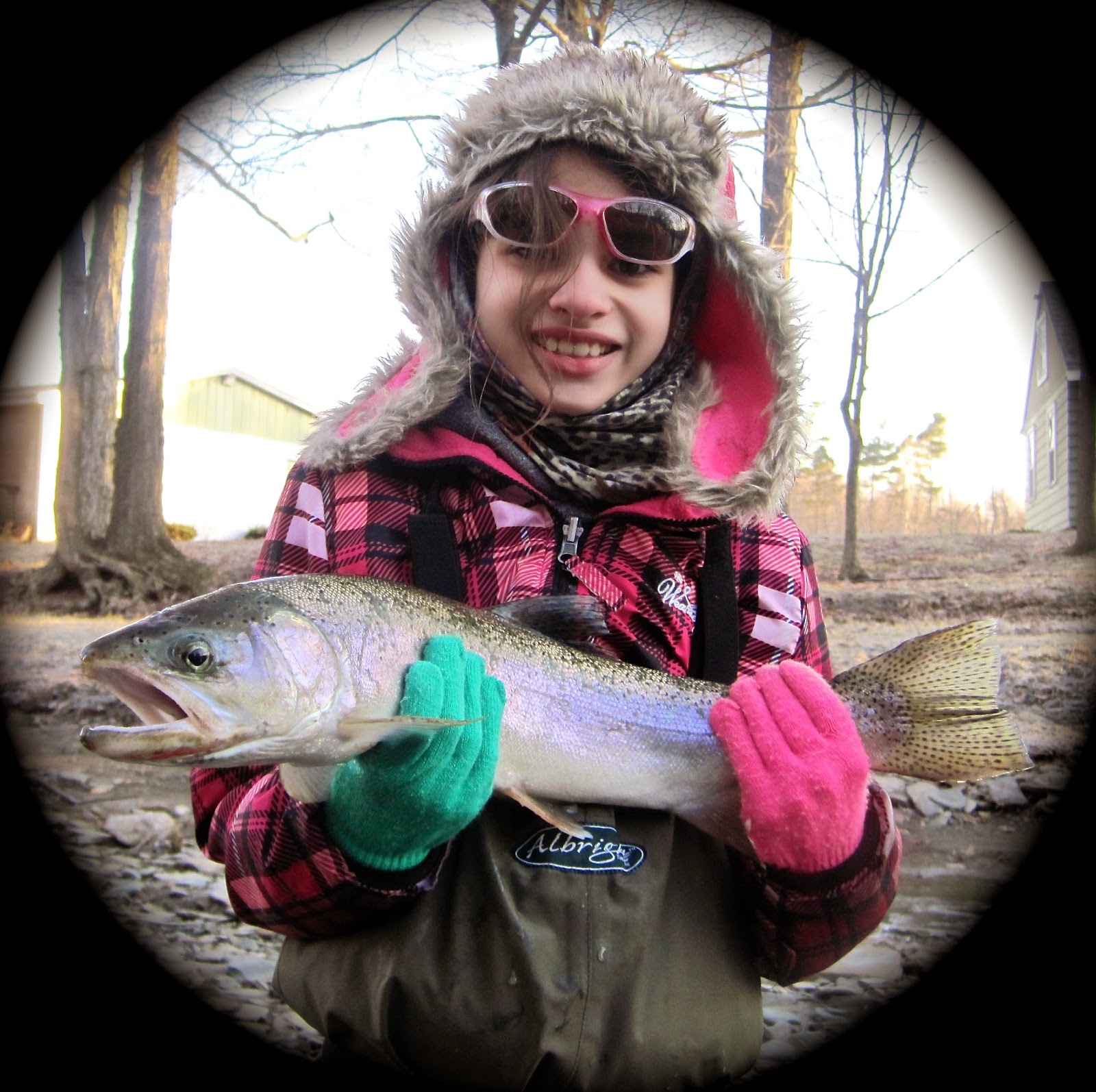
Rosey is 10 today. She wanted to catch her 1st steelhead on her birthday. So how could I turn that down? A quick 2 hours on the water and she hooked 3 fish. Not a bad birthday at all.

I'm proud of my baby girl because of whom she is becoming. And, it's pretty cool that she likes to hangout on the water with her dad. I hope her passion for fishing persists. I realize it may not. I will always cherish the memories we have on and off the water. But you're right, I hope I have a lifelong fishing partner and I hope her children have the same passion. Either way, I am so proud of my girl. She's growing up waaaaay too fast.


Saturday, March 15, 2014

Perfect 10!

Kicking off the Spring steelhead guide season has been long anticipated with this extreme Winter. Early in the season, you never know what to expect. Water temperatures are generally still pretty cool, but early stonefly and hex activity have the fish on the feed. Guiding new clients also keeps you on your toes for the unexpected.

Today was unexpected indeed. Most of the tributaries across Ohio and Pennsylvania began to open up over the past week and the rain we received 2 days ago really got things moving. And luckily, we found some water that had dropped enough to take a swing at.

John and Matt were primed and ready to hit the water. Matt is on his final weekend home for Spring
Break, so we had to make this day work. And work it did.

We hit the creek early and within no time John had hooked into his 1st steelhead. With a little coaching we were able to get it in the net. John was hooked!

Matt hooked several fish and had short battles with them, but they gave him the slip. Finally, BANG...Matt hit a serous gamer that ran him up and down the creek and this one did hit the net. Matt was now hooked as well!


From there, the water was on fire. By the end of the day, these 2 coaxed 10 fish into the net. As we walked back to the truck I reminded Matt how special this day really was because he spent it with his dad. They will both look back fondly 20 years from now at these memories burned into film. There is not much better in life than being able to guide a father and son on the water for a day and just watch them enjoy each other.


Want to make some memories on the water with a family member? Call me. LET'S GO FISHIN'!